Process discovery and governance
Process documentation that reflects how your business actually works.
Twiggy uses AI to interview the people who do the work, builds structured process models as they explain it, and has every detail validated by the people responsible. One connected process catalogue, from the enterprise overview to each activity.
No sign-up for either. Already have a workspace? Sign in.

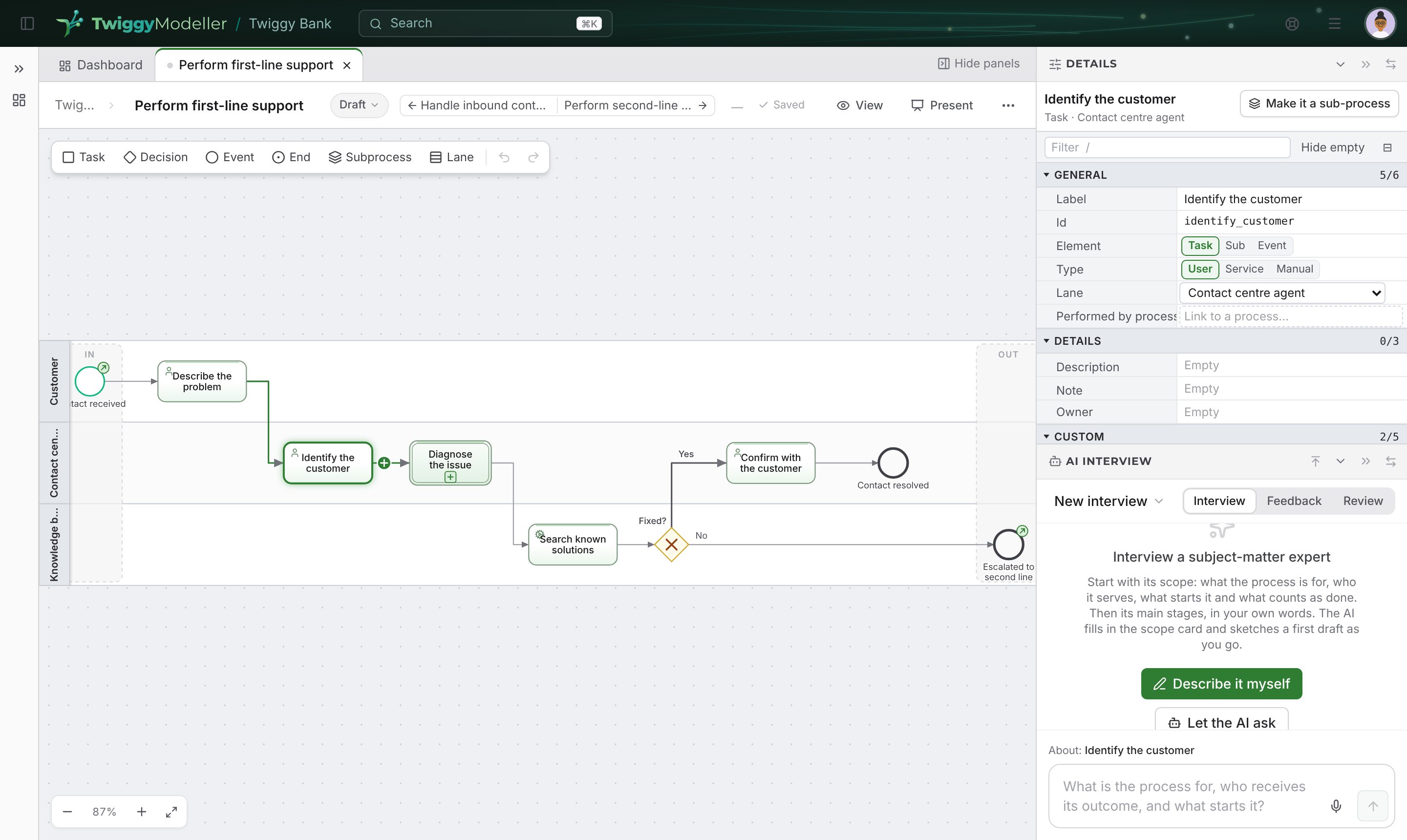
Discover, validate and keep it current
Most process documentation is incomplete, out of date, or written by people who don’t do the work. Twiggy starts from the people who do.
Discover
Capture how the work is really done, from the people who do it: interview them yourself, or let the AI ask, one question at a time, about what is missing.
Validate
Every model goes to the people responsible for it. They confirm what the AI assumed, comment and sign off from a link, with no account.
Connect
One catalogue from the enterprise overview to each activity. Hand-offs link one process to the next, so the whole chain hangs together.
Govern
Steps link to the systems, risks, controls, roles and requirements that matter, with owners, review dates and a health score that keeps it current.
Why Twiggy, and how it compares
- Process map health score
- AI clean-up review
- Risk and control registers
- Procedure guides
- Presentation mode
- Search inside every model
- BPMN 2.0 import and export
- Plain-text models you own
- Single sign-on (Corporate)
From a conversation to the catalogue
An expert describes their work
In their own words, to the AI, in a few minutes, on any device.
Twiggy asks questions
Who does this? What if it fails? It follows up on what was left out.
The process draws itself
Lanes, decisions and hand-offs appear as they answer, laid out automatically.
Assumptions are marked
Anything the AI inferred is marked ? until someone who knows confirms it.
The owner signs it off
The people responsible confirm or correct it, and approve.
It joins the catalogue
Connected to the map, the next process, and the risks and systems it touches.
See it on the demo bank How it works, step by step The process modelling guide
Not another diagramming tool
Traditional process tools help you document processes. Twiggy helps you discover, document and validate them, and keep them current.
| Topic | The traditional approach | With Twiggy |
|---|---|---|
| Access to SMEs | An analyst interviews whichever expert is available, and gets one view of how the process might work. | The analyst stays in control: Twiggy asks the right experts to confirm their part directly, or the AI interviews them, one at a time, whenever suits them. |
| Feedback loop | The analyst writes it up afterwards, some context is lost, and the experts’ time is needed again to review it. | The model is drafted as they talk, and gaps are asked about there and then. Exceptions are captured alongside the flow, and the AI keeps it plain or technical, as the audience needs. |
| Modelling effort | Most of the time and effort goes into making the model look good. | The layout is automatic, so every model reads the same way, and the framework keeps models small by design. |
| Keeping it relevant | Models drift out of date, and people stop trusting them. | Confirming is easy: the people responsible confirm what was assumed and sign off the model itself, and sign-off can renew on a schedule. |
| Processes are hard to find | Processes live in separate documents and drawings. | One connected catalogue: map, chains and flows, linked by their hand-offs. |
| Governance is secondary | Reviews happen when someone remembers. | Review dates, reminders and a health score keep it current. |
Start with one process
Pick a process that matters, interview someone who does it, and have its owner sign it off. Free to start, no card needed.